LipoDyne Official Website › Supplement Facts
Supplement FactsLipoDyne Supplement Facts
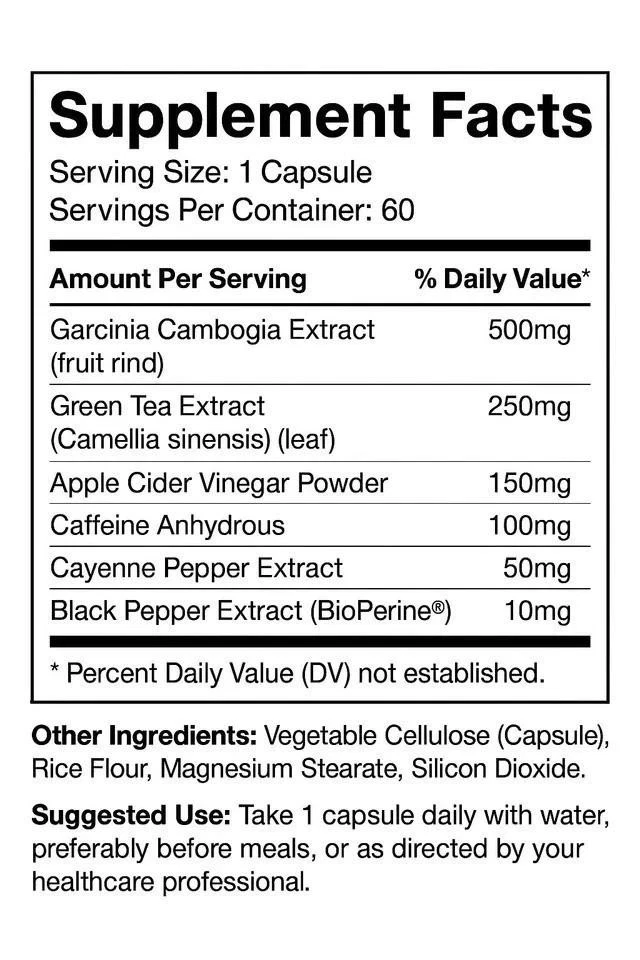
The LipoDyne Supplement Facts panel declares a serving of one capsule, 60 servings in the container, and six active rows with a milligram figure beside each one.
Those six come to 1,060 mg of actives per capsule. No Percent Daily Value appears against any row, four inactive lines run below the rule, and the suggested use sits under the panel rather than inside it.
Every row as the bottle prints it, the arithmetic that turns a panel into two months of capsules, and the one figure five of the six rows leave out.
What is printed on the LipoDyne Supplement Facts panel?
The bottle’s own three columns, in the bottle’s own order, with nothing added.
| Amount per serving | Weight | % Daily Value |
|---|---|---|
| Garcinia Cambogia Extract (fruit rind) | 500 mg | † |
| Green Tea Extract (Camellia sinensis) (leaf) | 250 mg | † |
| Apple Cider Vinegar Powder | 150 mg | † |
| Caffeine Anhydrous | 100 mg | † |
| Cayenne Pepper Extract | 50 mg | † |
| Black Pepper Extract (BioPerine®) | 10 mg | † |
Serving size one capsule. Servings per container 60. † marks a row for which no Percent Daily Value has been established. That is the panel’s own footnote, and it applies to all six rows.
A Supplement Facts panel is a declaration with a fixed order, and this one keeps it. The heading states the serving and the number of servings, the actives follow in descending weight, a footnote explains the symbol carried in the right-hand column, and the inactive lines sit below the rule under their own heading.
Descending weight is the part a reader can use straight away. The row at the top is the one the formulator spent the most of the capsule on, and on this bottle the top two rows carry 750 of the 1,060 milligrams between them.
How many servings are in a LipoDyne bottle?
One capsule, sixty servings, sixty days, and what that comes to over a bottle.
| Row | Per capsule | Per 60-capsule bottle | Per week at one a day |
|---|---|---|---|
| Garcinia Cambogia Extract | 500 mg | 30,000 mg | 3,500 mg |
| Green Tea Extract | 250 mg | 15,000 mg | 1,750 mg |
| Apple Cider Vinegar Powder | 150 mg | 9,000 mg | 1,050 mg |
| Caffeine Anhydrous | 100 mg | 6,000 mg | 700 mg |
| Cayenne Pepper Extract | 50 mg | 3,000 mg | 350 mg |
| Black Pepper Extract | 10 mg | 600 mg | 70 mg |
Arithmetic on the printed weights. Nothing in this table is a recommendation; it is the panel multiplied out so the container can be compared with a study, which reports its doses per day and per week rather than per capsule.
One capsule is the serving and the container holds 60 of them, so a bottle is sixty days at the label dose. That is an unusually long single container for this category, where a thirty-day bottle of two-a-day capsules is the norm, and it changes how the pack ladder reads.
It also changes how the guarantee reads. A refund window shorter than sixty days expires while the first bottle is still half full, which is why this desk says on the guarantee page that the term printed at checkout is worth screenshotting before you pay.
The right-hand column is there for anyone comparing this bottle with a published trial. Trials report a daily dose, so a weekly figure is the nearest thing to a common unit, and it makes the gap between 3,500 mg of garcinia extract a week here and 10,500 mg of hydroxycitric acid a week in the JAMA protocol immediately visible.
Why does the LipoDyne panel show no Daily Values?
One symbol runs down the whole right-hand column, and it answers a question the outer packaging raises.
Because a Daily Value only exists for a nutrient that has one, and none of these six rows is a nutrient in that sense.
Daily Values are reference figures set for vitamins, minerals and a handful of macronutrients. A botanical extract has no such reference, so the column is filled with a symbol and the footnote explains it. Every row on this panel carries the dagger, which tells you the formula is built entirely from botanicals and a stimulant rather than from anything with an established intake figure.
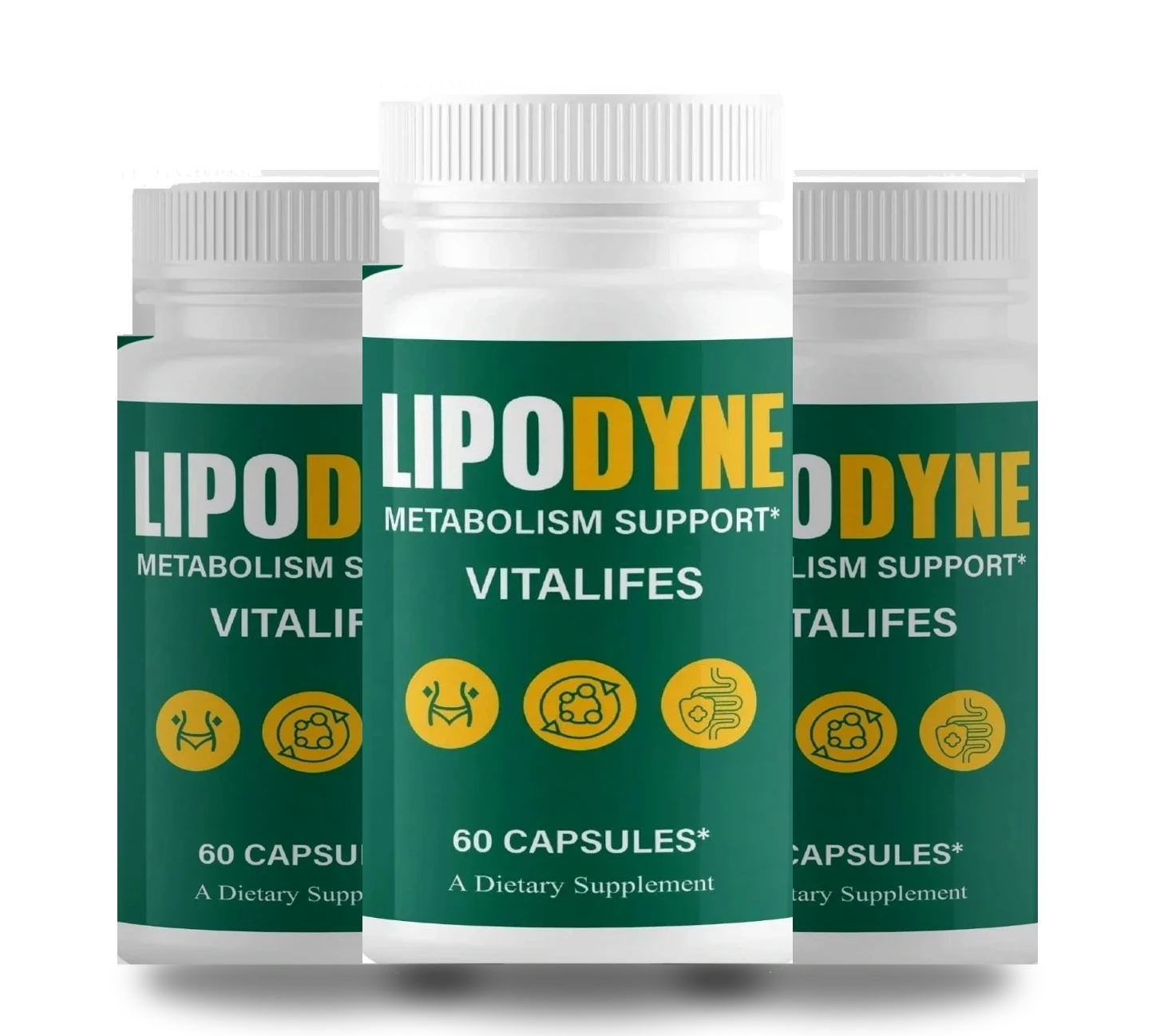
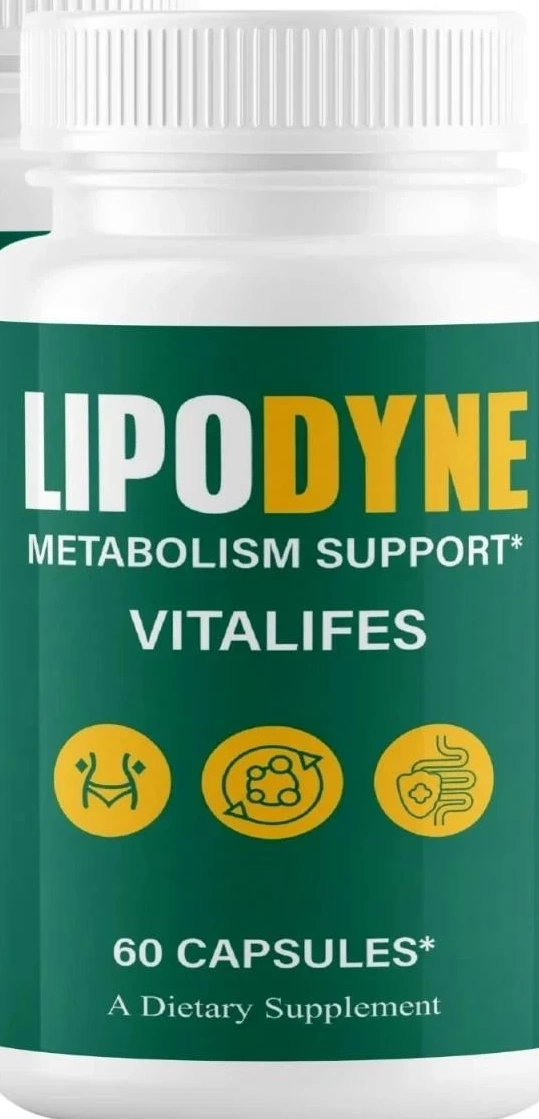
That matters for one particular reason on this bottle. The seller’s wellness artwork promises vital vitamins and minerals. A panel with a Daily Value column full of daggers is the direct evidence that the capsule contains neither, because a vitamin would have brought a percentage with it. The FDA’s own questions and answers on dietary supplements sets out what a panel is required to declare and why the column reads the way it does here.
What else is in a LipoDyne capsule besides the six actives?
Four lines under the panel, each with a job, and one of them answers a question buyers ask every week.
| Inactive line | What it is doing in the capsule |
|---|---|
| Vegetable Cellulose (Capsule) | The shell itself, made from plant cellulose rather than gelatin. It is the reason this capsule suits a vegetarian diet, and the panel is the only place that is stated. |
| Rice Flour | Filler. Six actives at 1,060 mg do not fill a capsule body on their own, and something inert has to occupy the rest or the fill weight varies between capsules. |
| Magnesium Stearate | A flow agent. It keeps powder moving through the encapsulation machine at speed, and it is the single most argued-about excipient in the industry at an inclusion rate of well under one per cent. |
| Silicon Dioxide | An anti-caking agent, there to stop the blend absorbing moisture and clumping before it reaches the capsule. |
The four lines below the rule, in the order the panel prints them.
Inactive is a regulatory word rather than a description. These four do a job, and on this bottle the first of them carries information the rest of the label never repeats: the shell is plant cellulose, so the capsule is suitable for a vegetarian diet.
What the other-ingredients line does not carry is an allergen statement. There is no "contains" line and no "manufactured in a facility that also processes" line on the artwork this desk has read. Anyone who needs one should ask the order desk for the current bottle’s full artwork before buying rather than relying on this page.
What does the LipoDyne panel not tell you?
Six rows carry an amount. Five of them still leave one figure out, and it is the same figure each time.
Five of the six rows are extract weights, and an extract weight is a measure of the powder rather than of the compound inside it. Two grams of a four-to-one extract and two grams of a fifty-to-one extract are the same number on a panel and different products in a capsule.
The one row that escapes this is caffeine anhydrous, because caffeine anhydrous is the compound, not a plant it was taken out of. One hundred milligrams is one hundred milligrams, and it is the only row on this panel a reader can carry straight to a study without converting anything.
There is a second arithmetic problem sitting underneath that. The green tea extract brings caffeine of its own, the panel totals only the anhydrous row, and no source can supply the caffeine content of this particular extract. The honest figure for a capsule is therefore 100 mg plus an unquantified amount, which is what the safety page works from.
How do I check the LipoDyne panel on my own bottle?
Five checks that take a minute and settle whether the bottle you received matches the one described here.
Read the serving line first
It should say one capsule and sixty servings. A panel declaring two capsules per serving is a different formulation, and every weight on it would need halving before it could be compared with the table above.
Check the six rows and their order
Garcinia 500, green tea 250, apple cider vinegar 150, caffeine 100, cayenne 50, black pepper 10. Descending weight, six rows, no proprietary blend heading grouping them under a single total.
Look for a standardisation percentage
If your bottle prints one, it carries information this desk has not seen, and it is worth sending to the address on the contact page. A panel that gains a figure between batches is a real change and this website will record it.
Match the lot on the base
Lot LIP-26/LI-7268 is the batch reference on file here. The batch page sets out what a lot code can and cannot prove.
Count the inactive lines
Four: vegetable cellulose, rice flour, magnesium stearate, silicon dioxide. A gelatin shell in place of the cellulose would make the capsule unsuitable for a vegetarian diet and that is worth knowing before the first one.
LipoDyne label questions
Does LipoDyne use a proprietary blend?
No. A proprietary blend groups several ingredients under one total weight, so no individual amount is visible. This panel prints a separate weight for all six rows, which is the more informative of the two formats and the less common one in this category.
How much of a LipoDyne capsule is active ingredient?
1,060 mg of the fill is the six declared actives. The rest is the four inactive lines, chiefly rice flour, plus the cellulose shell around them. The panel does not print a total fill weight, so the proportion cannot be stated exactly.
Is the LipoDyne capsule vegetarian?
The shell is vegetable cellulose, which is the plant alternative to gelatin, so the capsule itself suits a vegetarian diet. The artwork carries no vegetarian certification mark, and a mark and an ingredient line are different kinds of evidence.
Why is there no Daily Value on the LipoDyne panel?
Daily Values are set for vitamins, minerals and macronutrients. Every row here is a botanical extract or a stimulant, and none of those has a reference intake, so the column carries the dagger symbol and the panel’s own footnote explains it.
Does the LipoDyne panel list allergens?
The artwork read here carries no allergen statement and no facility line. Anyone with an allergy should ask the order desk for the current bottle’s full artwork before buying, because the answer can change between production runs.
Sources behind this LipoDyne label reading
The agency pages that define what a panel must declare, and the studies whose doses the weights above are compared against.
- Questions and Answers on Dietary Supplements. U.S. Food and Drug Administration. https://www.fda.gov/food/information-consumers-using-dietary-supplements/questions-and-answers-dietary-supplements
- Dietary Supplements: What You Need to Know. Office of Dietary Supplements, National Institutes of Health. https://ods.od.nih.gov/factsheets/WYNTK-Consumer/
- Seeram NP, Henning SM, Niu Y, et al. Catechin and caffeine content of green tea dietary supplements and correlation with antioxidant capacity. J Agric Food Chem. 2006;54(5):1599-603. PMID 16506807. https://pubmed.ncbi.nlm.nih.gov/16506807/
- Shoba G, Joy D, Joseph T, et al. Influence of piperine on the pharmacokinetics of curcumin in animals and human volunteers. Planta Med. 1998;64(4):353-6. PMID 9619120. https://pubmed.ncbi.nlm.nih.gov/9619120/
- Onakpoya I, Hung SK, Perry R, et al. The use of Garcinia extract (hydroxycitric acid) as a weight loss supplement: a systematic review and meta-analysis of randomised clinical trials. J Obes. 2011;2011:509038. PMID 21197150. https://pubmed.ncbi.nlm.nih.gov/21197150/
- Using Dietary Supplements Wisely. National Center for Complementary and Integrative Health, National Institutes of Health. https://www.nccih.nih.gov/health/using-dietary-supplements-wisely
Order LipoDyne with the panel in front of you
Six rows, an amount beside every one, 60 capsules to a bottle and sixty days at the label dose. The price and the guarantee term are the ones the seller prints at checkout.
One, three and six-bottle packs · price at checkout · money-back guarantee as printed on the listing
Order LipoDyne On The Official WebsiteOne capsule a day · 60 per bottle · lot LIP-26/LI-7268