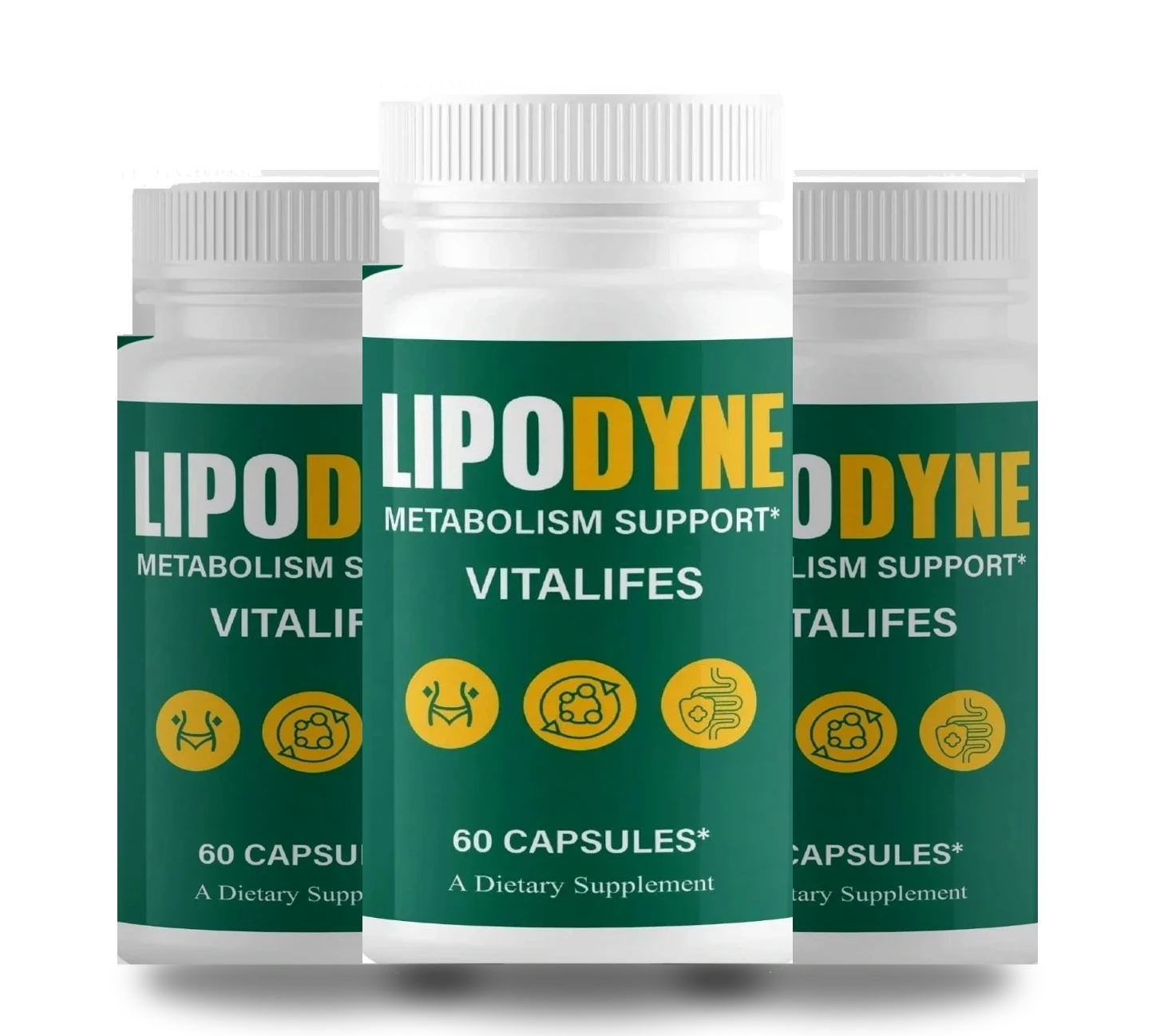
LipoDyne Official Website › Ingredients
IngredientsLipoDyne Ingredients
Six actives carry a printed weight on the LipoDyne bottle, and not one of them hides inside a blend.
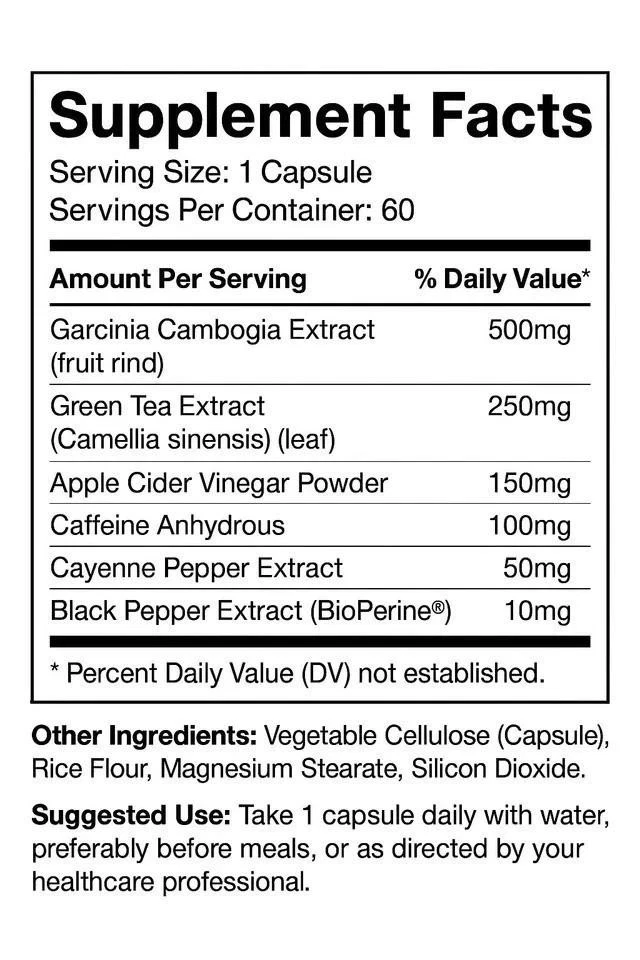
Garcinia cambogia extract 500 mg and green tea extract 250 mg lead the panel. Apple cider vinegar powder sits at 150 mg, caffeine anhydrous at 100 mg, cayenne pepper extract at 50 mg and black pepper extract at 10 mg. One capsule delivers all six, 1,060 mg in total.
The panel read straight down: each name, its milligrams, and what its studies were actually testing.
What does the LipoDyne label print?
Six rows and six weights, in the bottle’s own order, with a third column added.
| Row, as printed | Per capsule | Share of the capsule’s actives |
|---|---|---|
| Garcinia Cambogia Extract (fruit rind) | 500 mg | 47% |
| Green Tea Extract (Camellia sinensis) (leaf) | 250 mg | 24% |
| Apple Cider Vinegar Powder | 150 mg | 14% |
| Caffeine Anhydrous | 100 mg | 9% |
| Cayenne Pepper Extract | 50 mg | 5% |
| Black Pepper Extract (BioPerine®) | 10 mg | 1% |
Serving size one capsule, 60 servings a container. The right-hand column is arithmetic on the six printed weights, which total 1,060 mg. Under the panel run four inactive lines: vegetable cellulose (capsule), rice flour, magnesium stearate, silicon dioxide.
Two rows carry three quarters of the weight between them. The other four share what is left, and the smallest of them is there for a reason that has nothing to do with metabolism at all.
How many ingredients does LipoDyne have?
Two answers circulate for this formula and only one of them comes off the bottle.
Six, and the figure is worth stating plainly because two different answers circulate.
The seller’s sales page names no ingredient and gives no amount. A reader who arrives from there could reasonably conclude that the formula is undisclosed, and several third-party summaries have concluded exactly that.
The bottle settles it. The Supplement Facts panel is a regulated declaration, it carries six named actives, and it prints a milligram figure beside every one of them. Six is therefore the number this website works from, and it is the number that will be on the label in the box.
Where a sales page and a panel disagree, the panel governs, and this is the clearest case of that rule the estate has met so far: one side says nothing and the other says everything. If a bottle ever arrives whose panel reads differently from the table above, the batch page sets out what to do with it.
What are the six ingredients in LipoDyne?
Six actives, each with its own weight and its own research, one card at a time.
Each card carries the printed weight and, beside it, what the published work on that ingredient actually measured. Those two things are not the same, and the difference is the point of the card.
Garcinia Cambogia Extract
fruit rind of Garcinia gummi-gutta500 mg per capsuleA sour tropical fruit whose rind is dried and extracted for hydroxycitric acid, a compound that slows an enzyme in the fatty acid synthesis chain. Nearly half the active weight in this capsule is this one row.
The amount the research settled on is larger and better defined. The pooled analysis of twelve randomised trials worked in hydroxycitric acid rather than extract, and the two-week metabolic ward study that measured fat oxidation and energy expenditure directly reported no difference from placebo at the amount it used. One of the more interesting findings sits away from weight entirely: hydroxycitric acid raised muscle glycogen resynthesis after exercise.
This row is an extract weight. Turning 500 mg of extract into a hydroxycitric acid figure needs a percentage, and the bottle carries none, so the honest position is that the acid content of this capsule is a number nobody outside the factory holds.
Green Tea Extract
Camellia sinensis, leaf250 mg per capsuleDried tea leaf concentrated for its catechins, the largest of which is epigallocatechin gallate. It is the second heaviest row and the one with the widest spread of published results.
One meta-analysis reported a small effect on weight and a larger one on maintenance after weight loss. A second, run on a different trial set found the effect on body composition did not hold up. A third, restricted to energy expenditure looked at what the catechin does to the metabolic rate itself rather than to the scale.
Two practical notes belong on this row. Green tea extract carries caffeine of its own, so this row adds to the stimulant load beside the caffeine row below it. And a head-to-head trial against metformin is the reason some pages oversell it: that trial measured lipids and glycaemic control in overweight women, not weight loss in the general adult.
Apple Cider Vinegar Powder
dried, spray-dried onto a carrier150 mg per capsuleVinegar with the water taken out. The working compound is acetic acid, and the mechanism people reach for is the one that has the least to do with metabolism: acetic acid slows the stomach’s delivery of a meal into the intestine.
The literature here was built entirely on liquid. The pooled work on short-chain fatty acids covers the biochemistry acetic acid belongs to, and the gastric-emptying pilot measured the delay directly with a scan. Both used vinegar you pour.
A dried powder is a different preparation, and the panel states no acetic acid content, so the comparison between this row and those studies is a comparison between two things that share a name. The strongest part of the vinegar evidence, and the reason the label asks for the capsule before food, is covered on how it works.
Caffeine Anhydrous
pure compound, water removed100 mg per capsuleThe only row on this panel that is a single molecule rather than a plant extract, and therefore the only weight that is also a dose. One hundred milligrams is roughly what a mug of brewed coffee carries.
It is also the row with the shortest distance between the label and the research. A thermogenesis trial set caffeine against green tea and against a combination, and a brown adipose tissue study watched catechin and caffeine together raise cold-induced thermogenic capacity. Those two papers describe, in the laboratory, the pairing this panel puts in a capsule.
The practical consequence is simple arithmetic and it belongs in this card rather than in a warning box. Whatever you already drink in a day, this capsule adds at least 100 mg to it, and the green tea row adds an unstated amount on top.
Cayenne Pepper Extract
Capsicum annuum, fruit50 mg per capsuleChilli concentrated for its capsaicinoids, the compounds responsible for heat. They raise resting metabolic rate by a small, repeatedly measured amount and they blunt appetite slightly at the top of a meal.
The earlier systematic review of the question gathered the trials before the meta-analyses arrived, a later pooled analysis reported the energy expenditure and fat oxidation effects across human studies, and a dose-comparison trial in people with high BMI used the non-pungent capsinoid analogues that let a trial be blinded.
The number that would make this row checkable is the capsaicinoid percentage, and the bottle carries the extract weight alone. Fifty milligrams of a strong extract and 50 mg of a weak one are the same line on a label and two different experiences in a capsule.
Black Pepper Extract
BioPerine®, standardised piperine10 mg per capsuleThe smallest row, and the only one whose job is to act on the other five rather than on you. Piperine raises the absorption of compounds swallowed alongside it.
It manages that partly by keeping compounds away from the enzymes that would clear them. A formulation study sets out the three routes at once: solubility, membrane permeability and cytochrome P450 inhibition. That third route is the one with a consequence outside the bottle, and it is named once, by name, on the side effects page.
Ten milligrams is a small number attached to a real property. It is also the row a reader on any prescription should look at first, which is why it is the last card here and the first item there.
Which plant parts and forms does LipoDyne use?
Six rows, and whether each one arrives in the form its own literature was built on.
| Row | Part and form on this label | Form used in the human research |
|---|---|---|
| Garcinia cambogia | Fruit rind, as a dried extract | Hydroxycitric acid, measured as the acid rather than as the rind |
| Green tea | Leaf, as a dried extract | Leaf extract, but standardised and declared as milligrams of EGCG |
| Apple cider vinegar | Dried powder | Liquid vinegar, poured and measured in millilitres |
| Caffeine | Anhydrous, a pure compound | Anhydrous caffeine, the same compound at the same weight |
| Cayenne pepper | Fruit, as a dried extract | Capsaicinoids, measured as the compound rather than as the pepper |
| Black pepper | Fruit, as a standardised extract | Piperine, measured as the isolated alkaloid |
Read down the right-hand column and a pattern appears: the research counts the active compound, and the label counts the powder that carries it. On four of these six rows those are different units of measurement.
This is the most useful thing a reader can take away from a panel in this category, and it is not a criticism of this particular bottle. It is how supplement labelling works. A trial recruits people, gives them a measured quantity of a purified compound and reports what happened; a label lists the botanical powder that compound was pulled out of.
Two rows escape it. Caffeine anhydrous is sold as the molecule, so the weight and the dose are the same figure. Black pepper extract is standardised by convention to a high piperine content, which narrows the range even though the exact figure is not printed. The other four rows are extract weights, and an extract weight has a range rather than a value.
What is missing from the LipoDyne extract rows?
One clause per row would turn four weights into four doses, and it is not there.
What a standardisation clause looks like
Nine words on the end of a row: garcinia cambogia extract, standardised to 60 per cent hydroxycitric acid. With that clause, 500 mg becomes 300 mg of acid and a reader can hold it against a trial. Without it, 500 mg is a weight of powder.
What it costs a maker to print
Nothing beyond the testing already done to buy the raw material. Extract suppliers sell on assay, so the percentage exists on a certificate somewhere between the grower and the encapsulator. It is a decision about the label rather than a decision about the formula.
Which rows would gain most from it
Garcinia and green tea, in that order, because they are the two largest rows and the two whose trial doses are quoted in compound terms everywhere. Cayenne comes third: the published minimum for any effect on appetite is about 2 mg of capsaicinoids, which is 4 per cent of this row, and a percentage would settle in one word whether the row clears it.
What a reader can do instead
Treat the four extract rows as present rather than as quantified, and judge the capsule on the two rows that are quantified. That is a smaller product than the panel first appears to describe, and it is an honest one: 100 mg of caffeine and a piperine row doing exactly what piperine does.
Where do the LipoDyne amounts and the trials part company?
Six printed weights, grouped by how they sit against the research behind them.
Sorted by how each printed weight sits against the amount its own research used, the six rows fall into four groups rather than two.
| Where the row sits | Which rows | What follows from it |
|---|---|---|
| Level with the researched amount | Caffeine anhydrous 100 mg | A pure compound at the amount a published crossover gave. This row is what it says it is, and it is the reason anything is felt in the first hour. |
| Close to the researched amount | Black pepper extract 10 mg | The absorption study used 20 mg of piperine. Ten milligrams of a standardised extract is within sight of that, and the row is on the panel to change absorption rather than to move a metabolic outcome. |
| Below it, in a unit that cannot be converted | Garcinia 500 mg, green tea 250 mg, cayenne 50 mg | Three extract weights with no standardisation percentage. Each sits under the trial amount once converted, and by how much cannot be worked out from the bottle. |
| A different preparation entirely | Apple cider vinegar powder 150 mg | Every human trial poured liquid vinegar and measured it by volume. This is dried powder in a capsule, which is a different experiment rather than a smaller one. |
Every figure in the middle column is printed on the bottle. The right-hand column is what this desk concludes from it, and a reader who disagrees has the same numbers to work from.
Two of the six rows carry caffeine: 100 mg of caffeine anhydrous, plus whatever rides in on 250 mg of green tea extract. The bottle totals neither, and no source can supply the second figure for this particular extract. Treat a capsule as at least 100 mg and count it in the day rather than on top of it.
What else is inside a LipoDyne capsule?
Four entries under the panel, one of which decides the purchase for some buyers.
Four lines account for everything that is not an active: vegetable cellulose (capsule), rice flour, magnesium stearate, silicon dioxide. None of them is a nutrient and none of them is there for effect.
Vegetable cellulose, the shell
A plant-derived polymer, and the alternative to gelatin. It dissolves in the stomach, holds a dry powder without sticking, and settles a question some buyers ask before anything else: the shell itself is suitable for a vegetarian diet. Who it is for takes that further.
Rice flour, the filler
Bulk. Six actives at their printed weights come to 1,060 mg, which does not fill a capsule of this size, so something inert has to occupy the rest and keep every capsule the same weight. Rice flour is the usual choice and carries no gluten.
Magnesium stearate, the flow agent
A lubricant that stops powder sticking to the machinery that fills the capsules. It appears in a large share of pressed and encapsulated products, and the quantity involved is a fraction of a milligram of magnesium.
Silicon dioxide, the anti-caking agent
Finely divided silica, added so a hygroscopic powder does not clump on its way into the shell. Apple cider vinegar powder in particular pulls moisture out of the air, which is the practical reason this line is on the label at all.
LipoDyne ingredient questions
How many ingredients are in LipoDyne?
Six actives, each with its own printed milligram figure, plus four inactive lines: vegetable cellulose (capsule), rice flour, magnesium stearate, silicon dioxide. The seller’s sales page names none of them; the Supplement Facts panel on the bottle names all six.
Is there a proprietary blend?
No. Every active has its own row and its own weight, which is why each one on this page can be set beside a trial amount at all. A blend line would make that impossible.
Which ingredient is present in the largest amount?
Garcinia cambogia extract at 500 mg per capsule, then green tea extract at 250 mg. Those two carry roughly seven tenths of the 1,060 mg of actives between them.
How much hydroxycitric acid does a capsule contain?
The row reads 500 mg of garcinia cambogia extract with no standardisation percentage beside it, and the acid content cannot be derived without that figure. The pooled trials worked in hydroxycitric acid and used far more of it than 500 mg of extract could supply.
How much EGCG is in the green tea extract?
Same answer for the same reason: the row is 250 mg of extract, and EGCG is a fraction of an extract rather than the whole of it. The trial that moved weight used 856.8 mg of EGCG a day.
Why is black pepper extract in a metabolism capsule?
To raise how much of the other rows crosses the gut wall. Piperine does that partly by inhibiting a cytochrome P450 enzyme, which is a real property with a real consequence for anyone on a prescription. The side effects page names the enzyme and the medicines it clears.
Is LipoDyne vegetarian?
The capsule shell is vegetable cellulose rather than gelatin, so the shell is suitable. The remaining inactive lines are rice flour, magnesium stearate and silicon dioxide, none of which is animal-derived.
Sources for the LipoDyne ingredient list
Every study named above, in the order the panel lists the ingredient it belongs to.
- Onakpoya I, Hung SK, Perry R, et al. The use of Garcinia extract (hydroxycitric acid) as a weight loss supplement: a systematic review and meta-analysis of randomised clinical trials. J Obes. 2011;2011:509038. PMID 21197150. https://pubmed.ncbi.nlm.nih.gov/21197150/
- Kovacs EM, Westerterp-Plantenga MS, Saris WH. The effects of 2-week ingestion of (-)-hydroxycitrate and (-)-hydroxycitrate combined with medium-chain triglycerides on satiety, fat oxidation, energy expenditure and body weight. Int J Obes Relat Metab Disord. 2001;25(7):1087-94. PMID 11443511. https://pubmed.ncbi.nlm.nih.gov/11443511/
- Cheng IS, Huang SW, Lu HC, et al. Oral hydroxycitrate supplementation enhances glycogen synthesis in exercised human skeletal muscle. Br J Nutr. 2012;107(7):1048-55. PMID 21824444. https://pubmed.ncbi.nlm.nih.gov/21824444/
- Hursel R, Viechtbauer W, Westerterp-Plantenga MS. The effects of green tea on weight loss and weight maintenance: a meta-analysis. Int J Obes (Lond). 2009;33(9):956-61. PMID 19597519. https://pubmed.ncbi.nlm.nih.gov/19597519/
- Baladia E, Basulto J, Manera M, et al. Effect of green tea or green tea extract consumption on body weight and body composition: systematic review and meta-analysis. Nutr Hosp. 2014;29(3):479-90. PMID 24558988. https://pubmed.ncbi.nlm.nih.gov/24558988/
- Kapoor MP, Sugita M, Fukuzawa Y, et al. Physiological effects of epigallocatechin-3-gallate (EGCG) on energy expenditure for prospective fat oxidation in humans: a systematic review and meta-analysis. J Nutr Biochem. 2017;43:1-10. PMID 27883924. https://pubmed.ncbi.nlm.nih.gov/27883924/
- Alves Ferreira M, Oliveira Gomes AP, Guimaraes de Moraes AP, et al. Green tea extract outperforms metformin in lipid profile and glycaemic control in overweight women: a double-blind, placebo-controlled, randomized trial. Clin Nutr ESPEN. 2017;22:1-6. PMID 29415825. https://pubmed.ncbi.nlm.nih.gov/29415825/
- Cherta-Murillo A, Pugh JE, Alaraj-Alshehhi S, et al. The effects of SCFAs on glycemic control in humans: a systematic review and meta-analysis. Am J Clin Nutr. 2022;116(2):335-361. PMID 35388874. https://pubmed.ncbi.nlm.nih.gov/35388874/
- Hlebowicz J, Darwiche G, Bjorgell O, et al. Effect of apple cider vinegar on delayed gastric emptying in patients with type 1 diabetes mellitus: a pilot study. BMC Gastroenterol. 2007;7:46. PMID 18093343. https://pubmed.ncbi.nlm.nih.gov/18093343/
- Belza A, Toubro S, Astrup A. The effect of caffeine, green tea and tyrosine on thermogenesis and energy intake. Eur J Clin Nutr. 2009;63(1):57-64. PMID 17882140. https://pubmed.ncbi.nlm.nih.gov/17882140/
- Yoneshiro T, Matsushita M, Hibi M, et al. Tea catechin and caffeine activate brown adipose tissue and increase cold-induced thermogenic capacity in humans. Am J Clin Nutr. 2017;105(4):873-881. PMID 28275131. https://pubmed.ncbi.nlm.nih.gov/28275131/
- Whiting S, Derbyshire E, Tiwari BK. Capsaicinoids and capsinoids: a potential role for weight management? A systematic review of the evidence. Appetite. 2012;59(2):341-8. PMID 22634197. https://pubmed.ncbi.nlm.nih.gov/22634197/
- Zsiboras C, Matics R, Hegyi P, et al. Capsaicin and capsiate could be appropriate agents for treatment of obesity: a meta-analysis of human studies. Crit Rev Food Sci Nutr. 2018;58(9):1419-1427. PMID 28001433. https://pubmed.ncbi.nlm.nih.gov/28001433/
- Inoue N, Matsunaga Y, Satoh H, et al. Enhanced energy expenditure and fat oxidation in humans with high BMI scores by the ingestion of novel and non-pungent capsaicin analogues (capsinoids). Biosci Biotechnol Biochem. 2007;71(2):380-9. PMID 17284861. https://pubmed.ncbi.nlm.nih.gov/17284861/
- Yu D, Kan Z, Shan F, et al. Triple strategies to improve oral bioavailability by fabricating coamorphous forms of ursolic acid with piperine: enhancing water-solubility, permeability, and inhibiting cytochrome P450 isozymes. Mol Pharm. 2020;17(12):4443-4462. PMID 32926628. https://pubmed.ncbi.nlm.nih.gov/32926628/
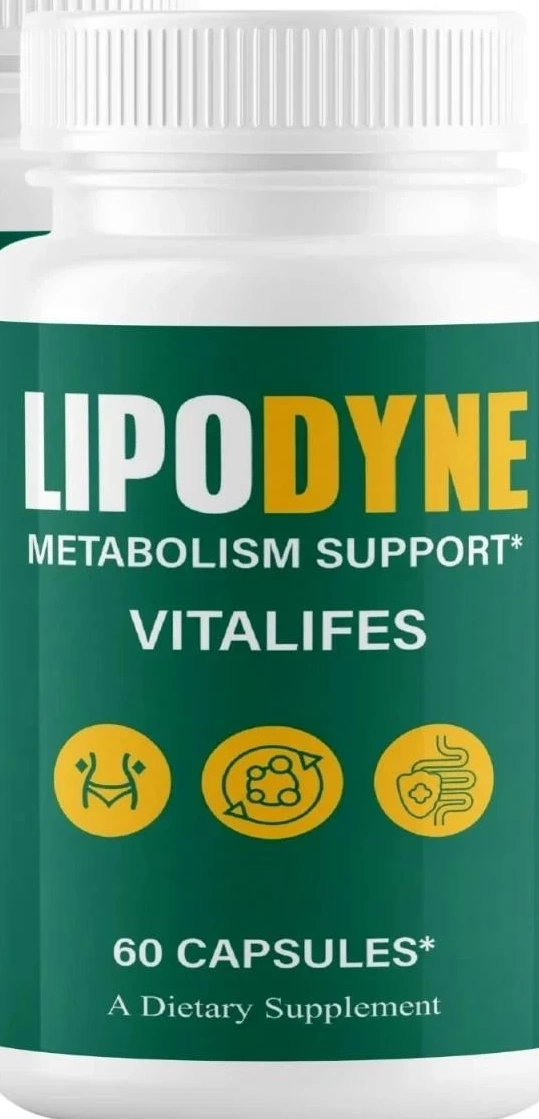
Order LipoDyne with all six amounts in front of you
Six actives, six printed weights, 60 capsules a bottle and one a day, with the current price and guarantee term shown at the seller’s checkout.
One, three and six-bottle packs · price at checkout · money-back guarantee as printed on the listing
Order LipoDyne On The Official WebsiteOne capsule a day · 60 per bottle · lot LIP-26/LI-7268