LipoDyne Official Website › Metabolism Supplement Guide
Metabolism Supplement GuideMetabolism Supplement Guide: What The Evidence Shows
A metabolism supplement can plausibly do four things, and the published effect sizes for all four are small.
It can raise energy expenditure slightly, blunt appetite slightly, change how much of something else is absorbed, or shift which fuel is burned. This guide covers what the research found for each, and why label amounts and trial amounts so rarely agree.
Organised by mechanism rather than by ingredient, so that it works on any label in the aisle rather than on one bottle.
The four things a metabolism supplement can plausibly do
Four plausible routes, what each actually means, and the best result published for each.
| Mechanism | What it means | Typical ingredients | Best published effect |
|---|---|---|---|
| Thermogenesis | Raising the calories burned at rest or after a meal. | Caffeine, capsaicinoids, green tea catechins | Tens of calories a day, measured in laboratory conditions. |
| Appetite and satiety | Eating less because you feel full sooner or want food less. | Hydroxycitric acid, capsaicinoids, acetic acid | Inconsistent. Some trials find a reduction in intake, many find none. |
| Absorption and carriage | Changing how much of a co-administered compound reaches the blood. | Piperine from black pepper | Large for specific passengers, and no effect on metabolism itself. |
| Substrate use | Shifting the mix of fat and carbohydrate burned at a given intensity. | Caffeine, catechins | Measurable in exercise studies, and not the same thing as losing weight. |
The right-hand column is the best result in the published human literature for each mechanism, not a claim about any particular product.
Two of those four are what the marketing in this aisle is about. The third is a supporting act that never appears on a front panel, and the fourth is routinely presented as though it were the first.
The distinction between substrate use and energy balance is the one that causes the most confusion. Burning a higher proportion of fat during a given hour is a real, reproducible laboratory finding. It tells you nothing on its own about whether the day ended in a deficit, which is the thing that decides whether stored fat goes anywhere.
A guide that respected the evidence would spend most of its length on the first mechanism, because that is where the numbers are. So this one does.
Thermogenesis: what an extra thirty-four calories looks like
The mechanism with the most reliable evidence, and the size of the number it produces.
This is the mechanism with the most reliable evidence and the smallest effect, which is an awkward combination for a category built on it.
Caffeine is the clearest case in the literature and the easiest to reason about. A published crossover gave 100 mg, an ordinary cup of coffee, and measured the response. Work on thermogenic ingredients over longer periods and research on brown adipose tissue fill in the mechanism. The direction is consistent and the magnitude is modest.
Capsaicinoids, the pungent fraction of chilli, are the second-clearest. The pooled analysis of resting metabolic rate puts the effect at roughly 34 kcal a day. That is a real number produced by real trials, and it is about a third of an apple.
Green tea catechins are the third. A meta-analysis of catechin and caffeine mixtures found effects on weight maintenance, and an energy expenditure study measured the response directly. The doses involved are the story and they are covered further down.
- About 34 kcal a day is the pooled capsaicinoid effect on resting metabolic rate.
- 100 mg of caffeine is roughly one cup of coffee, and is a measured, repeatable dose.
- 2 mg of capsaicinoids is the published minimum below which nothing is expected to happen to energy intake.
- A pound of body fat is about 3,500 kcal, which is a hundred days of the first number.
That last line is the honest frame for the whole mechanism. Thirty-four calories a day is not nothing, and it is also not a strategy. It is the sort of effect that shows up in a controlled trial with a metabolic cart attached to somebody and disappears entirely into the noise of an ordinary week.
Appetite: the mechanism with the most trials and the least agreement
The most studied route in this aisle, and why its trials keep disagreeing with each other.
Appetite is where most of this category’s marketing lives and where its literature is least settled.
Hydroxycitric acid, the compound garcinia cambogia is grown for, is the most studied example and the most instructive. A satiety crossover used 900 mg a day and reported effects on intake. The largest randomised trial gave 1,500 mg a day for twelve weeks to 135 people and found no difference from placebo on body weight or fat mass. A meta-analysis of twelve trials later pooled everything and arrived at about 0.88 kg.
Read those three together and a pattern emerges that repeats across the category. Small studies with mechanistic endpoints find something. The largest trial with the hardest endpoint finds nothing. The pooled figure lands somewhere small and is dominated by the smaller studies.
Acetic acid, the active fraction of vinegar, tells a similar story from a different direction. The twelve-week Japanese trial gave 15 or 30 mL of liquid vinegar daily and reported modest reductions. A 2025 meta-analysis found the signal concentrated in the higher-dose subgroup, which is what a real dose response looks like.
A 2024 trial reporting substantial reductions in weight, body mass index and body fat across 120 adolescents given vinegar is the single most cited apple cider vinegar result on the internet. It has been retracted, with the notice published in 2025. Any page still quoting it is quoting a paper that is no longer part of the literature.
Absorption: the row that changes the other rows
The ingredient class that changes other ingredients, and the question it raises.
One ingredient class on a metabolism panel is not there to do anything to metabolism at all.
Piperine, the pungent compound in black pepper, is an absorption modifier. The study that made it famous gave 20 mg of piperine alongside a poorly absorbed compound and raised its bioavailability substantially. Work on intestinal permeability describes part of the mechanism.
That makes it genuinely useful on a panel whose other rows are poorly absorbed, and it makes it worth a second thought for a different reason. Piperine is a mechanism-based inactivator of CYP3A, one of the main enzymes the body uses to clear medicines. An ingredient that raises the absorption of what is in the capsule can raise the blood level of what is in the prescription too.
This is the row to notice on any label that carries it, and it is almost never the row a front panel is talking about. If you take anything prescribed, it is the single most worthwhile sentence on the back of the bottle.
The practical reading: an absorption row is a reason a formula might work better than the sum of its amounts, and a reason to check the interaction before assuming it is inert. Both halves of that sentence are true at once.
How big is a real effect in this category?
Five published results that together describe the ceiling of this whole category.
| Published result | What it was | In plain terms |
|---|---|---|
| About 34 kcal a day | Pooled capsaicinoid effect on resting metabolic rate. | Roughly a third of an apple, measured under laboratory conditions. |
| About 0.88 kg | Pooled hydroxycitric acid effect across twelve trials. | Under two pounds, over trials running weeks to months. |
| No difference from placebo | The largest randomised garcinia trial, 135 people, twelve weeks, 1,500 mg a day. | The biggest study with the hardest endpoint found nothing. |
| Modest reductions | Twelve weeks of 15 or 30 mL of liquid vinegar daily. | Real, dose-dependent, and achieved with a tablespoon rather than a capsule. |
| Clinically insignificant | A twelve-week randomised trial of a commercial thermogenic blend, in its own authors’ words. | The closest thing in the literature to a multi-ingredient burner. |
Five results that between them describe the ceiling of this category. Each one is the best or the largest available for its mechanism.
The last row is the one worth sitting with. That trial randomised a commercial multi-ingredient thermogenic product for twelve weeks, which is precisely the thing this aisle sells, and its own authors described the changes as clinically insignificant.
There is no equivalent trial showing the opposite. The category’s strongest evidence is for isolated compounds at doses higher than commercial products carry, and its evidence for finished multi-ingredient products is thin and unflattering.
That does not make these products worthless. It makes them small, and it means anyone expecting a capsule to do the work of a diet has been sold an expectation that the literature never supported.
Why label amounts and trial amounts so rarely agree
Two reasons the amount on a bottle and the amount in a trial keep failing to correspond.
Two reasons, and the second one is the one almost nobody notices.
The first is volume. A trial dose is often more material than a capsule can physically hold at a sensible serving. 1,500 mg of hydroxycitric acid a day is a large amount of powder, and a formula carrying five other ingredients has no room for it.
The second is the unit. Research counts the active fraction. Labels print the extract weight. Those are different quantities and the ratio between them is set by a standardisation percentage that a label is not required to state.
So a panel reading 250 mg of green tea extract is not comparable to a trial that gave 856.8 mg of EGCG, and the gap between them cannot be computed without a percentage. Measured catechin content across commercial green tea supplements varies enough that the same extract weight can mean very different things.
Read the last row on its own and the discipline becomes obvious. Caffeine anhydrous is the only common metabolism ingredient where the label unit and the research unit are the same thing, which is exactly why it is the only row on a panel like this that can be checked in ten seconds.
What these products are allowed to claim
Why the bottle is more cautious than the advertisement beside it.
Support, and nothing stronger.
A dietary supplement in the United States may carry a structure and function claim: a statement that it supports a normal bodily process. It may not claim to treat, prevent or cure anything, and it is not approved before sale. That is why the same disclaimer appears on every bottle in the aisle.
The practical consequence is a gap that a reader can use. A bottle’s own label is written under that ceiling and is therefore fairly cautious. The advertising around it frequently is not, because a banner is not a label.
So when a front panel says one modest thing and a website beside it promises something large, the modest thing is the one written under legal constraint. Trust the bottle over the banner, every time.
The NCCIH guidance on using supplements wisely and the FDA’s own questions and answers set out the framework in full, and the NIH Office of Dietary Supplements consumer fact sheet is the plainest single summary of it.
The short version, for somebody deciding tonight
What to take away if you read nothing else on this page.
What the evidence supports
- Caffeine works, at a dose you can read off a label, and its effects are immediate and repeatable.
- Capsaicinoids have a real pooled effect on resting metabolic rate, about 34 kcal a day.
- Green tea catechins have genuine evidence at doses well above what most capsules carry.
- An absorption row can make a formula worth more than the sum of its amounts.
- A panel that prints every amount is a meaningfully better object than one that hides behind a blend total.
What it does not
- The largest garcinia trial found nothing, and it is the largest trial in the category.
- The most quoted apple cider vinegar result has been withdrawn from the literature.
- Trials of finished multi-ingredient thermogenic products have been unflattering.
- Extract weights cannot be converted into doses without a percentage most labels omit.
- Nothing in this aisle produces an effect on the scale that its advertising implies.
A metabolism capsule is a small lever. Used by somebody who already has the large levers moving, it is a reasonable thing to try for eight to twelve weeks with one measurement written down each week.
Bought as a substitute for them, it is a purchase that disappoints on a schedule: roughly three weeks, which is when the first-week stimulant novelty has worn off and nothing slower has arrived yet. That is the honest summary of everything above, and it holds whichever bottle you pick up.
Sources behind this guide
Twenty-five records, every one retrieved from the National Library of Medicine or a federal health agency, including one retraction notice.
- Van Schaik L, Kettle C, Green R, et al. Both caffeine and Capsicum annuum fruit powder lower blood glucose levels and increase brown adipose tissue temperature in healthy adult males. Front Physiol. 2022;13:870154. PMID 36017333. https://pubmed.ncbi.nlm.nih.gov/36017333/
- Belza A, Toubro S, Astrup A. The effect of caffeine, green tea and tyrosine on thermogenesis and energy intake. Eur J Clin Nutr. 2009;63(1):57-64. PMID 17882140. https://pubmed.ncbi.nlm.nih.gov/17882140/
- Yoneshiro T, Matsushita M, Hibi M, et al. Tea catechin and caffeine activate brown adipose tissue and increase cold-induced thermogenic capacity in humans. Am J Clin Nutr. 2017;105(4):873-881. PMID 28275131. https://pubmed.ncbi.nlm.nih.gov/28275131/
- Gong Z, Yu S, Lyu Z, et al. Effects of different caffeine doses on fat oxidation and cardiovascular response during exercise at FATmax in overweight/obese female college students. J Int Soc Sports Nutr. 2026;23(1):2670558. PMID 42120324. https://pubmed.ncbi.nlm.nih.gov/42120324/
- Nawrot P, Jordan S, Eastwood J, et al. Effects of caffeine on human health. Food Addit Contam. 2003;20(1):1-30. PMID 12519715. https://pubmed.ncbi.nlm.nih.gov/12519715/
- Irandoost P, Lotfi Yagin N, Namazi N, et al. The effect of capsaicinoids or capsinoids in red pepper on thermogenesis in healthy adults: a systematic review and meta-analysis. Phytother Res. 2021;35(3):1358-1377. PMID 33063385. https://pubmed.ncbi.nlm.nih.gov/33063385/
- Whiting S, Derbyshire EJ, Tiwari B. Could capsaicinoids help to support weight management? A systematic review and meta-analysis of energy intake data. Appetite. 2014;73:183-8. PMID 24246368. https://pubmed.ncbi.nlm.nih.gov/24246368/
- Inoue N, Matsunaga Y, Satoh H, et al. Enhanced energy expenditure and fat oxidation in humans with high BMI scores by the ingestion of novel and non-pungent capsaicin analogues (capsinoids). Biosci Biotechnol Biochem. 2007;71(2):380-9. PMID 17284861. https://pubmed.ncbi.nlm.nih.gov/17284861/
- Hursel R, Viechtbauer W, Westerterp-Plantenga MS. The effects of green tea on weight loss and weight maintenance: a meta-analysis. Int J Obes (Lond). 2009;33(9):956-61. PMID 19597519. https://pubmed.ncbi.nlm.nih.gov/19597519/
- Kapoor MP, Sugita M, Fukuzawa Y, et al. Physiological effects of epigallocatechin-3-gallate (EGCG) on energy expenditure for prospective fat oxidation in humans: a systematic review and meta-analysis. J Nutr Biochem. 2017;43:1-10. PMID 27883924. https://pubmed.ncbi.nlm.nih.gov/27883924/
- Mielgo-Ayuso J, Barrenechea L, Alcorta P, et al. Effects of dietary supplementation with epigallocatechin-3-gallate on weight loss, energy homeostasis, cardiometabolic risk factors and liver function in obese women: randomised, double-blind, placebo-controlled clinical trial. Br J Nutr. 2014;111(7):1263-71. PMID 24299662. https://pubmed.ncbi.nlm.nih.gov/24299662/
- Seeram NP, Henning SM, Niu Y, et al. Catechin and caffeine content of green tea dietary supplements and correlation with antioxidant capacity. J Agric Food Chem. 2006;54(5):1599-603. PMID 16506807. https://pubmed.ncbi.nlm.nih.gov/16506807/
- Heymsfield SB, Allison DB, Vasselli JR, et al. Garcinia cambogia (hydroxycitric acid) as a potential antiobesity agent: a randomized controlled trial. JAMA. 1998;280(18):1596-600. PMID 9820262. https://pubmed.ncbi.nlm.nih.gov/9820262/
- Onakpoya I, Hung SK, Perry R, et al. The use of Garcinia extract (hydroxycitric acid) as a weight loss supplement: a systematic review and meta-analysis of randomised clinical trials. J Obes. 2011;2011:509038. PMID 21197150. https://pubmed.ncbi.nlm.nih.gov/21197150/
- Westerterp-Plantenga MS, Kovacs EM. The effect of (-)-hydroxycitrate on energy intake and satiety in overweight humans. Int J Obes Relat Metab Disord. 2002;26(6):870-2. PMID 12037659. https://pubmed.ncbi.nlm.nih.gov/12037659/
- Kondo T, Kishi M, Fushimi T, et al. Vinegar intake reduces body weight, body fat mass, and serum triglyceride levels in obese Japanese subjects. Biosci Biotechnol Biochem. 2009;73(8):1837-43. PMID 19661687. https://pubmed.ncbi.nlm.nih.gov/19661687/
- Castagna A, Aliperti A, Marino F, et al. Effect of apple cider vinegar intake on body composition in humans with type 2 diabetes and/or overweight: a systematic review and meta-analysis. Nutrients. 2025;17(18):2905. PMID 41010525. https://pubmed.ncbi.nlm.nih.gov/41010525/
- Abou-Khalil R, Andary J, El-Hayek E. Apple cider vinegar for weight management in Lebanese adolescents and young adults with overweight and obesity: a randomised, double-blind, placebo-controlled study. BMJ Nutr Prev Health. 2024;7(1):61-67. PMID 38966098. RETRACTED: BMJ Nutr Prev Health. 2025;8(2):693. https://pubmed.ncbi.nlm.nih.gov/38966098/
- Shoba G, Joy D, Joseph T, et al. Influence of piperine on the pharmacokinetics of curcumin in animals and human volunteers. Planta Med. 1998;64(4):353-6. PMID 9619120. https://pubmed.ncbi.nlm.nih.gov/9619120/
- Cui T, Wang Q, Tian X, et al. Piperine is a mechanism-based inactivator of CYP3A. Drug Metab Dispos. 2020;48(2):123-134. PMID 31748224. https://pubmed.ncbi.nlm.nih.gov/31748224/
- Yu D, Kan Z, Shan F, et al. Triple strategies to improve oral bioavailability by fabricating coamorphous forms of ursolic acid with piperine: enhancing water-solubility, permeability, and inhibiting cytochrome P450 isozymes. Mol Pharm. 2020;17(12):4443-4462. PMID 32926628. https://pubmed.ncbi.nlm.nih.gov/32926628/
- Sowinski RJ, Grubic TJ, Dalton RL, et al. An examination of a novel weight loss supplement on anthropometry and indices of cardiovascular disease risk. J Diet Suppl. 2021;18(5):478-506. PMID 32691639. https://pubmed.ncbi.nlm.nih.gov/32691639/
- Using Dietary Supplements Wisely. National Center for Complementary and Integrative Health, National Institutes of Health. https://www.nccih.nih.gov/health/using-dietary-supplements-wisely
- Questions and Answers on Dietary Supplements. U.S. Food and Drug Administration. https://www.fda.gov/food/information-consumers-using-dietary-supplements/questions-and-answers-dietary-supplements
- Dietary Supplements: What You Need to Know. Office of Dietary Supplements, National Institutes of Health. https://ods.od.nih.gov/factsheets/WYNTK-Consumer/
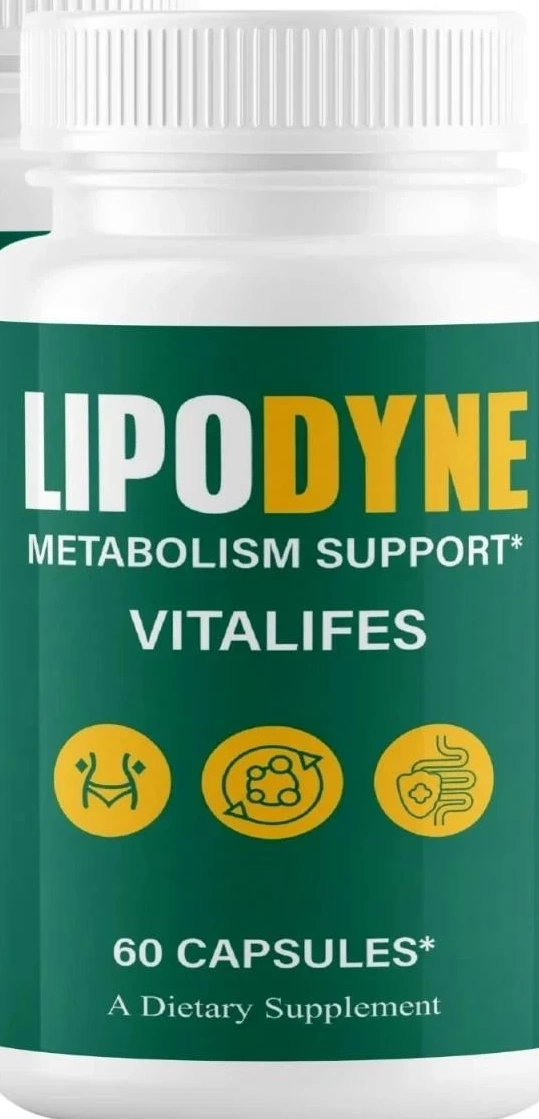
Now read the LipoDyne panel with all of that in hand
Six actives with every amount printed, one capsule a day, and the trial dose set beside each label amount so the arithmetic above can be done on this bottle.
One, three and six-bottle packs · price at checkout · money-back guarantee as printed on the listing
Order LipoDyne On The Official WebsiteOne capsule a day · 60 per bottle · lot LIP-26/LI-7268