LipoDyne Official Website › Blog › A Thermogenic Blend Trial
Somebody Ran A Trial On A Thermogenic Blend
Almost all the evidence in this category is for single compounds, tested one at a time, at doses no capsule carries. Occasionally somebody randomises a finished commercial product instead. That is a rarer and much more relevant thing, and it is worth knowing how it went.
- The evidence behind thermogenic formulas is almost entirely single-ingredient work.
- A twelve-week randomised trial of a commercial multi-ingredient thermogenic product exists.
- Its own authors described the changes it produced as clinically insignificant.
- There is no comparable trial of a finished blend reporting the opposite.
- A formula can underperform its parts for four separate reasons, and only one of them is visible on a label.
The gap between what is sold and what is studied
Walk down this aisle and every product is a combination. Four, six, eight ingredients in one capsule, each chosen because it has a literature behind it.
Open that literature and almost none of it is about combinations. It is about caffeine on its own, catechins on their own, capsaicinoids on their own, hydroxycitric acid on its own, each tested in isolation at a dose chosen to give the compound its best chance.
That gap is the central problem in evaluating anything in this category, and it is not dishonesty on anybody’s part. Trials are expensive, and a trial of a finished commercial product benefits only that product, so almost nobody funds one.
| Ingredient class | Best single-ingredient result | What it was measured as |
|---|---|---|
| Caffeine | A measurable rise in energy expenditure and fat oxidation. | 100 mg in a crossover; higher doses in longer work. |
| Green tea catechins | Effects on weight maintenance in pooled analysis. | Hundreds of milligrams of EGCG a day. |
| Capsaicinoids | About 34 kcal a day on resting metabolic rate. | Milligrams of capsaicinoids, pooled across trials. |
| Hydroxycitric acid | About 0.88 kg pooled; nothing in the largest trial. | 900 to 1,500 mg a day of the acid. |
Four classes that turn up in almost every thermogenic formula, and the best result published for each on its own.
Each of those rows is a genuine result. The caffeine crossover, the catechin meta-analysis, the capsaicinoid pooling and the hydroxycitric acid pooling are all real published work. What none of them is, is a test of a capsule containing all four.
What the blend trial did
The trial in question randomised a commercial multi-ingredient thermogenic supplement against a control and ran it for twelve weeks, measuring body composition and related outcomes.
Twelve weeks is the right length for this question. It is long enough for a small daily energy difference to accumulate into something measurable, and it is the span most of the single-ingredient literature also uses.
A finished commercial product is also the right subject. It carries the doses a real consumer takes, in the ratios a real formulator chose, with whatever interactions exist between the parts. That is a considerably more useful thing to randomise than a single compound at a laboratory dose.
Which makes the result the interesting part
If multi-ingredient thermogenics worked at the scale their marketing implies, a twelve-week randomised trial of one is where it would show up most clearly.
What its authors concluded
That the changes observed were clinically insignificant. That is their assessment of their own data, not a hostile reading of it by somebody selling something else.
Clinically insignificant is a specific phrase and worth unpacking. It does not necessarily mean nothing moved. It means that whatever moved was too small to matter to the person it moved in, which is the standard that actually counts for a consumer product.
That is a harder test than statistical significance, and it is the right one here. A difference can be statistically real and practically irrelevant, and a category selling body composition change should be judged on the second.
There is no equivalent trial of a finished thermogenic blend reporting a clinically meaningful effect. The strongest evidence in this category remains single-ingredient work at doses commercial capsules do not carry.
Why single-ingredient evidence does not simply add up
This is the reasoning error the whole category rests on, and it is an easy one to make honestly.
If caffeine raises energy expenditure, and catechins raise energy expenditure, and capsaicinoids raise resting metabolic rate, then a capsule containing all three should raise it by the sum of the three. That is intuitive, and it is not how biology works.
Work on thermogenic ingredients over longer periods is instructive here: effects that appear in acute measurement do not necessarily persist, and combinations are not reliably additive. Two compounds acting through overlapping pathways can produce considerably less than the sum of their separate effects.
And the doses shrink. A capsule with six ingredients in it carries less of each than a single-ingredient capsule would, because there is only so much room. So the arithmetic is usually not even a sum of full effects; it is a sum of fractions of them.
Four ways a blend underperforms its parts
| Why a blend can underperform its parts | What happens | Can a label tell you? |
|---|---|---|
| Each ingredient is below its own trial dose | A formula fits six things into a capsule by carrying less of each than any trial used. | Only if the standardisation is printed. Usually it is not. |
| The effects do not add up | Two ingredients acting on the same pathway may not produce twice the effect. | No. This needs the blend itself to be trialled. |
| The endpoint is the hard one | Energy expenditure moves; body weight over twelve weeks frequently does not. | No. This is about trial design, not labelling. |
| Participants are not in a deficit | A few tens of calories a day cannot overcome an intake that has not changed. | No, and it is the largest of the four. |
Four mechanisms by which a formula whose parts all have evidence can produce a null result. Only the first is visible on a label.
The fourth row is the largest and the least discussed. Thirty-four calories a day, or even a hundred, is a small number set against an intake that varies by several hundred from one day to the next.
A supplement producing a real but tiny expenditure effect in somebody whose eating has not changed will produce no visible outcome at all, and that is not a failure of the supplement so much as a description of its scale.
- A capsule cannot hold a trial dose of six things at once.
- Overlapping mechanisms do not stack cleanly.
- Twelve-week body composition is a hard endpoint, and expenditure changes are small.
- Daily intake variation is larger than anything a capsule contributes.
- None of that means the ingredients do nothing. It means the finished product is smaller than the sum of its citations.
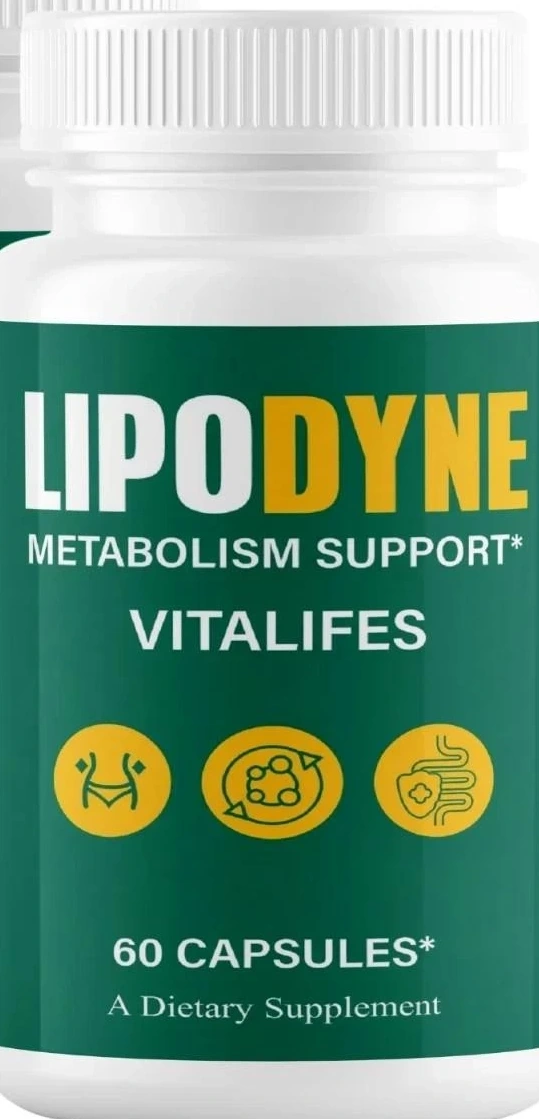
What the LipoDyne panel actually carries
Six rows, every amount printed, and the dose each published trial used set beside it. Reading that page is the fastest way to see how much of each is really in there.
One, three and six-bottle packs · price at checkout · money-back guarantee as printed on the listing
Order LipoDyne On The Official WebsiteOne capsule a day · 60 per bottle · lot LIP-26/LI-7268
What that trial can and cannot say about this bottle
It can say something general and nothing specific, and the distinction is worth keeping clean.
It was not a trial of this product. It used a different formula at different amounts, and no result from it transfers to this capsule any more than a garcinia trial transfers to it.
What it does supply is a prior. When the one randomised test of a finished thermogenic blend produces a result its authors call clinically insignificant, a buyer holding another finished thermogenic blend has a reasonable basis for modest expectations.
That is how a prior should work: it shifts what you expect without pretending to be a measurement of the thing in front of you. Broader data on supplement-related harms performs a similar function on the safety side, describing a category rather than a bottle.
What a convincing trial would look like
- Randomised, placebo-controlled and double-blind, with the placebo matched for appearance and for the stimulant, which is the hard part when caffeine is in the formula.
- Twelve weeks minimum, which is the span the single-ingredient literature uses.
- The finished product at its label dose, not a research formulation at a research dose.
- Body composition measured properly rather than body weight on a home scale.
- Intake recorded, so that a null result can be distinguished from participants eating more.
- Published with the protocol registered in advance and the results reported whichever way they came out.
No product on this shelf, including this one, has been through that. Saying so is more useful than implying otherwise, and a reader who knows it can weigh a purchase accordingly.
The upshot for somebody deciding
A thermogenic capsule is a small lever with real ingredients in it, and the one trial of a finished version of that idea came out flat.
The sensible conclusion is not that these products are inert. It is that they are small, that their evidence sits one layer below the thing being sold, and that anybody expecting a capsule to do the work of an intake change has been set up for a disappointment that will arrive in about three weeks.
Eight to twelve weeks, one measurement a week written down, and honest expectations about the size of the effect. That is what the evidence in this category supports, and it is what this website says rather than anything larger.
Because the alternative is selling an expectation the literature does not support, and a buyer who is disappointed in three weeks is a buyer who was told the wrong thing before they paid.
References
- Sowinski RJ, Grubic TJ, Dalton RL, et al. An examination of a novel weight loss supplement on anthropometry and indices of cardiovascular disease risk. J Diet Suppl. 2021;18(5):478-506. PMID 32691639. https://pubmed.ncbi.nlm.nih.gov/32691639/
- Van Schaik L, Kettle C, Green R, et al. Both caffeine and Capsicum annuum fruit powder lower blood glucose levels and increase brown adipose tissue temperature in healthy adult males. Front Physiol. 2022;13:870154. PMID 36017333. https://pubmed.ncbi.nlm.nih.gov/36017333/
- Belza A, Toubro S, Astrup A. The effect of caffeine, green tea and tyrosine on thermogenesis and energy intake. Eur J Clin Nutr. 2009;63(1):57-64. PMID 17882140. https://pubmed.ncbi.nlm.nih.gov/17882140/
- Hursel R, Viechtbauer W, Westerterp-Plantenga MS. The effects of green tea on weight loss and weight maintenance: a meta-analysis. Int J Obes (Lond). 2009;33(9):956-61. PMID 19597519. https://pubmed.ncbi.nlm.nih.gov/19597519/
- Onakpoya I, Hung SK, Perry R, et al. The use of Garcinia extract (hydroxycitric acid) as a weight loss supplement: a systematic review and meta-analysis of randomised clinical trials. J Obes. 2011;2011:509038. PMID 21197150. https://pubmed.ncbi.nlm.nih.gov/21197150/
- Irandoost P, Lotfi Yagin N, Namazi N, et al. The effect of capsaicinoids or capsinoids in red pepper on thermogenesis in healthy adults: a systematic review and meta-analysis. Phytother Res. 2021;35(3):1358-1377. PMID 33063385. https://pubmed.ncbi.nlm.nih.gov/33063385/
- Geller AI, Shehab N, Weidle NJ, et al. Emergency department visits for adverse events related to dietary supplements. N Engl J Med. 2015;373(16):1531-40. PMID 26465986. https://pubmed.ncbi.nlm.nih.gov/26465986/