LipoDyne Official Website › Blog › The Retracted ACV Trial
The Apple Cider Vinegar Trial That Was Withdrawn
One 2024 paper is responsible for most of what the internet believes about vinegar and body weight. It is no longer part of the literature, the notice was published in 2025, and a great many pages selling capsules have not noticed.
- A 2024 trial reporting large reductions in weight, body mass index and body fat across 120 young people is the most cited apple cider vinegar result on the internet.
- That paper has been retracted. The bibliographic record now carries the publication type Retracted Publication, with the notice published in 2025.
- A retraction removes a paper from the evidence base. It is not a disagreement about it.
- What still stands for vinegar is older, smaller and measured in millilitres of liquid: 15 or 30 mL a day over twelve weeks.
- Every surviving weight trial poured liquid. None of them tested a dried powder in a capsule.
What the 2024 paper reported
The study randomised 120 overweight and obese adolescents and young adults to apple cider vinegar or a control, and followed them for twelve weeks. It reported reductions in body weight, body mass index, waist and hip circumference, and body fat ratio.
Those are large, clean, quotable outcomes across a decent-sized sample. In a field whose pooled effects are usually measured in fractions of a kilogram, a paper reporting several kilograms across four months stands out immediately.
It stood out enough that within weeks it had been summarised by national newspapers, repeated by health sites, condensed into social posts and printed on the back of a large number of supplement pages. It became, very quickly, the thing everybody knew about vinegar.
| Claim that circulated | Where it came from | Status of that source now |
|---|---|---|
| Vinegar cut body weight in 120 young people | A 2024 trial in a nutrition journal, widely summarised in the consumer press. | Withdrawn. The record carries the publication type Retracted Publication. |
| It reduced body mass index and body fat as well | The same paper, same cohort, same twelve weeks. | Withdrawn with the rest of it. |
| Results appeared within four weeks | The same paper’s timeline, repeated everywhere it was summarised. | Withdrawn. |
| A tablespoon a day is enough | A conflation of that paper with the older Japanese work on liquid vinegar. | The older work stands; the 2024 figures do not. |
Four statements that travelled together, and the single source three of them rested on.
Why it travelled so far, so fast
Three properties made it unusually portable, and none of them is about the quality of the work.
It confirmed something people already half-believed. Vinegar as a weight remedy is old folklore, and a trial that appears to vindicate folklore gets a warmer reception than one that contradicts it.
It produced a single sentence. Twelve weeks, 120 young people, weight down. That fits in a headline, in a caption and in a product description, which the more typical finding in this area does not.
And it arrived with a number attached
A result with figures in it feels checkable even when nobody checks it. Once a percentage or a kilogram figure is circulating, it gets copied rather than re-derived, and each copy carries the authority of the last one rather than of the paper.
That is the mechanism by which a single study becomes a fact. Nothing about it requires bad faith, and it is why the withdrawal of one paper can leave hundreds of pages carrying its conclusions.
What a retraction actually is
A retraction is a formal statement by a journal that a published paper should no longer be relied upon. It is the strongest correction the scientific record has.
It is worth separating from two weaker things it is often confused with. A correction fixes an error in a paper that otherwise stands. A rebuttal or a failed replication is a disagreement, and disagreements are ordinary and productive.
A retraction is neither. It removes the paper from the evidence base. The reasons vary and are stated in the notice, but the consequence does not vary: a retracted result is not weakened evidence, it is not evidence.
A retracted paper cannot be cited in support of anything. It can be cited as an example of a retraction, which is the only way it appears anywhere on this website.
What the record says today
The bibliographic record for that paper now carries the publication type “Retracted Publication”, and the retraction notice was published in the same journal in September 2025. Both are visible on the public record, which is the point of a retraction notice: it is designed to be found by anybody who goes looking.
That last phrase is the whole difficulty. Almost nobody goes looking. A page written in early 2025 citing the trial was, at the time, citing a live paper in good standing. Nothing about that page changed when the notice appeared, and nothing notified its author.
So the retraction is in the record and the claim is still in circulation, and both of those things will be true for years.
What is left standing for vinegar
Rather more than nothing, and considerably less than the headline implied.
A twelve-week randomised trial in adults with obesity gave 15 mL or 30 mL of vinegar a day and reported modest reductions in body weight, waist circumference and visceral fat. It is older, smaller and much quieter than the 2024 paper, and it is still there.
A 2025 meta-analysis pooled the available anthropometric trials and found the signal concentrated in the higher-dose subgroup, which is what a genuine dose response looks like rather than a statistical artefact.
Away from weight, work on post-meal glucose is the better-replicated finding, and mechanistic work on short-chain fatty acids describes what acetate does once it is absorbed. Neither is a weight-loss result and neither is presented as one here.
| What survived | What it measured | What it used |
|---|---|---|
| A twelve-week randomised trial in adults | Body weight, waist and visceral fat in people with obesity. | 15 mL or 30 mL of liquid vinegar a day, by volume. |
| A 2025 meta-analysis | Pooled anthropometric outcomes across the available trials. | Signal concentrated in the higher-dose subgroup. |
| Post-meal glucose work | Blood glucose response after a carbohydrate meal. | Liquid vinegar, taken with the meal. |
| Mechanistic work on short-chain fatty acids | How acetate behaves once absorbed. | Not a weight outcome at all. |
Everything still standing for vinegar measures liquid by volume. None of it measured a dried powder in a capsule.
Powder, liquid, and the unit problem
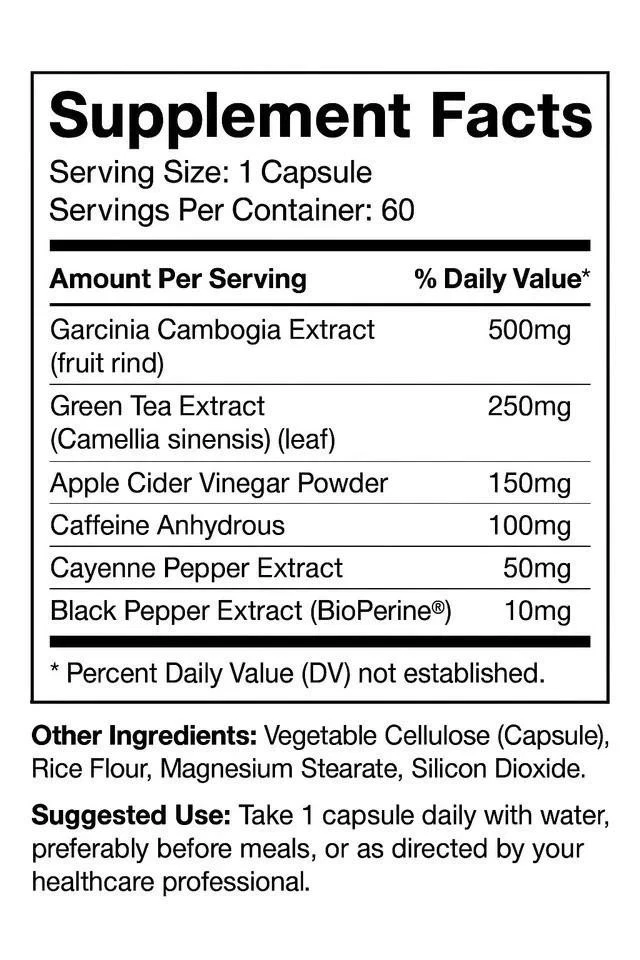
Every trial above poured a liquid and measured it in millilitres. This panel prints 150 mg of dried powder, and those are not the same quantity expressed differently.
15 mL of vinegar at five per cent acidity carries roughly 750 mg of acetic acid, and 30 mL carries roughly 1,500 mg. Dried apple cider vinegar powder is a carrier with vinegar solids on it, at an acetic acid content that varies by product and is not stated on this label.
So the honest position on this row is that its amount is printed, its acetic acid content is not, and the comparison with the trials cannot be completed from the bottle. That is stated once, with the other five rows, on the ingredients page.
- The trials measured liquid vinegar by volume, daily, for twelve weeks.
- This panel prints a dried powder by weight, at 150 mg per capsule.
- The acetic acid figure that would connect them is not printed.
- Nothing on this website claims the row reproduces the trials, because it cannot be shown to.
See every LipoDyne amount, including this one
Six actives, a milligram figure against every row, and the dose each published trial used printed beside it. The vinegar row is the third of six and it is not the strongest.
One, three and six-bottle packs · price at checkout · money-back guarantee as printed on the listing
Order LipoDyne On The Official WebsiteOne capsule a day · 60 per bottle · lot LIP-26/LI-7268
How to check whether a source is still current
It takes about twenty seconds and almost nobody does it.
Find the paper on the public bibliographic record rather than on the page that told you about it. Search the title, open the record, and look at the publication type and at any banner above the abstract. A retracted paper says so there, and a corrected one links to its correction.
If a page cites a study without giving you enough to find it, that is itself informative. A citation that names the journal, the year and the identifier expects to be checked. A citation reading “studies show” does not.
- Take the title, not the summary, from the page you are reading.
- Look it up on the public record rather than on a search engine’s summary card.
- Read the publication type and any notice above the abstract.
- Check the dose the trial used, which is in the abstract and is almost never in the marketing.
- Compare that dose with the amount on the bottle in your hand.
Four questions to ask of any supplement citation
These four apply well beyond vinegar, and they are the habit this article is really about.
- Is the paper still current? Retractions happen, notices are published, and nothing propagates them to the pages that cited the work.
- What dose did it use? A trial dose and a label amount agree far less often than the page quoting both would suggest.
- What form did it use? Liquid, powder, extract and isolated compound are four different things, and a study of one is not a study of the others.
- Who was in it? A result in adolescents, in athletes or in people with a diagnosis is not automatically a result in you.
Because the row it is about is on the bottle this website sells, and the strongest number anyone could have quoted for that row has been withdrawn. Leaving it uncited would have been quieter. Saying why it is uncited is more useful.
Vinegar is not a fraud and this is not an argument that it does nothing. It is an argument that the thing most people believe about it rests on a paper that no longer exists, and that what is left is smaller, older and measured in a unit that no capsule can carry.
Read the panel, check the acetic acid figure, and notice when it is not there. That habit is worth more than any single row on any single label.
References
- Abou-Khalil R, Andary J, El-Hayek E. Apple cider vinegar for weight management in Lebanese adolescents and young adults with overweight and obesity: a randomised, double-blind, placebo-controlled study. BMJ Nutr Prev Health. 2024;7(1):61-67. PMID 38966098. RETRACTED: BMJ Nutr Prev Health. 2025;8(2):693. https://pubmed.ncbi.nlm.nih.gov/38966098/
- Kondo T, Kishi M, Fushimi T, et al. Vinegar intake reduces body weight, body fat mass, and serum triglyceride levels in obese Japanese subjects. Biosci Biotechnol Biochem. 2009;73(8):1837-43. PMID 19661687. https://pubmed.ncbi.nlm.nih.gov/19661687/
- Castagna A, Aliperti A, Marino F, et al. Effect of apple cider vinegar intake on body composition in humans with type 2 diabetes and/or overweight: a systematic review and meta-analysis. Nutrients. 2025;17(18):2905. PMID 41010525. https://pubmed.ncbi.nlm.nih.gov/41010525/
- Shishehbor F, Mansoori A, Shirani F. Vinegar consumption can attenuate postprandial glucose and insulin responses: a systematic review and meta-analysis of clinical trials. Diabetes Res Clin Pract. 2017;127:1-9. PMID 28292654. https://pubmed.ncbi.nlm.nih.gov/28292654/
- Cherta-Murillo A, Pugh JE, Alaraj-Alshehhi S, et al. The effects of SCFAs on glycemic control in humans: a systematic review and meta-analysis. Am J Clin Nutr. 2022;116(2):335-361. PMID 35388874. https://pubmed.ncbi.nlm.nih.gov/35388874/
- Hlebowicz J, Darwiche G, Bjorgell O, et al. Effect of apple cider vinegar on delayed gastric emptying in patients with type 1 diabetes mellitus: a pilot study. BMC Gastroenterol. 2007;7:46. PMID 18093343. https://pubmed.ncbi.nlm.nih.gov/18093343/
- Maladkar SR, Yadav P, Muniraja ANA, et al. Erosive effect of acidic beverages and dietary preservatives on extracted human teeth: an in vitro analysis. Eur J Dent. 2022;16(4):919-929. PMID 35436789. https://pubmed.ncbi.nlm.nih.gov/35436789/